Reconstitution
L-arginine does not have one universal reconstitution procedure. Commercial injectable products may already be supplied as sterile solutions.

L-arginine is a proteinogenic amino acid and nitric-oxide precursor involved in vascular signaling, the urea cycle, protein metabolism and multiple physiological processes. This research reference examines L-arginine identity, formulation, reconstitution, diluent selection, concentration calculations, stability, sterile quality and human clinical research.

Does L-arginine commonly require reconstitution? Not universally. L-arginine is available in oral products and in pre-formulated injectable preparations. A current L-arginine HCl injectable product is supplied as a sterile, nonpyrogenic 100 mg/mL solution, meaning the commercial injectable formulation itself is not presented as a powder that requires routine reconstitution.
Is bacteriostatic water an established universal diluent? No. BacScience does not consider BAC water a universal L-arginine diluent for unspecified research powders.
Are reconstitution instructions formulation-specific? Yes. The salt or chemical form, intended route, concentration, pH, excipients, container, sterility requirements and validated stability data all matter.
What determines concentration? For a simple mathematical solution, concentration is the amount of L-arginine divided by the final solution volume. However, the mathematical concentration does not establish sterility, stability, compatibility or suitability for administration.
These six research cards provide the key information a researcher should establish before attempting to interpret an L-arginine concentration or reconstitution question.
L-arginine does not have one universal reconstitution procedure. Commercial injectable products may already be supplied as sterile solutions.
Do not assume bacteriostatic water is appropriate for an unspecified L-arginine powder. The exact formulation must establish compatibility.
Concentration is determined mathematically from compound quantity and final volume.
Injectable material requires appropriate pharmaceutical quality, identity, sterility, endotoxin control and manufacturing documentation.
Human studies have investigated oral and intravenous L-arginine for vascular, metabolic and other research questions.
Regulatory status depends on the exact product, formulation, route and jurisdiction. A research powder should not be treated as equivalent to an approved injectable product.
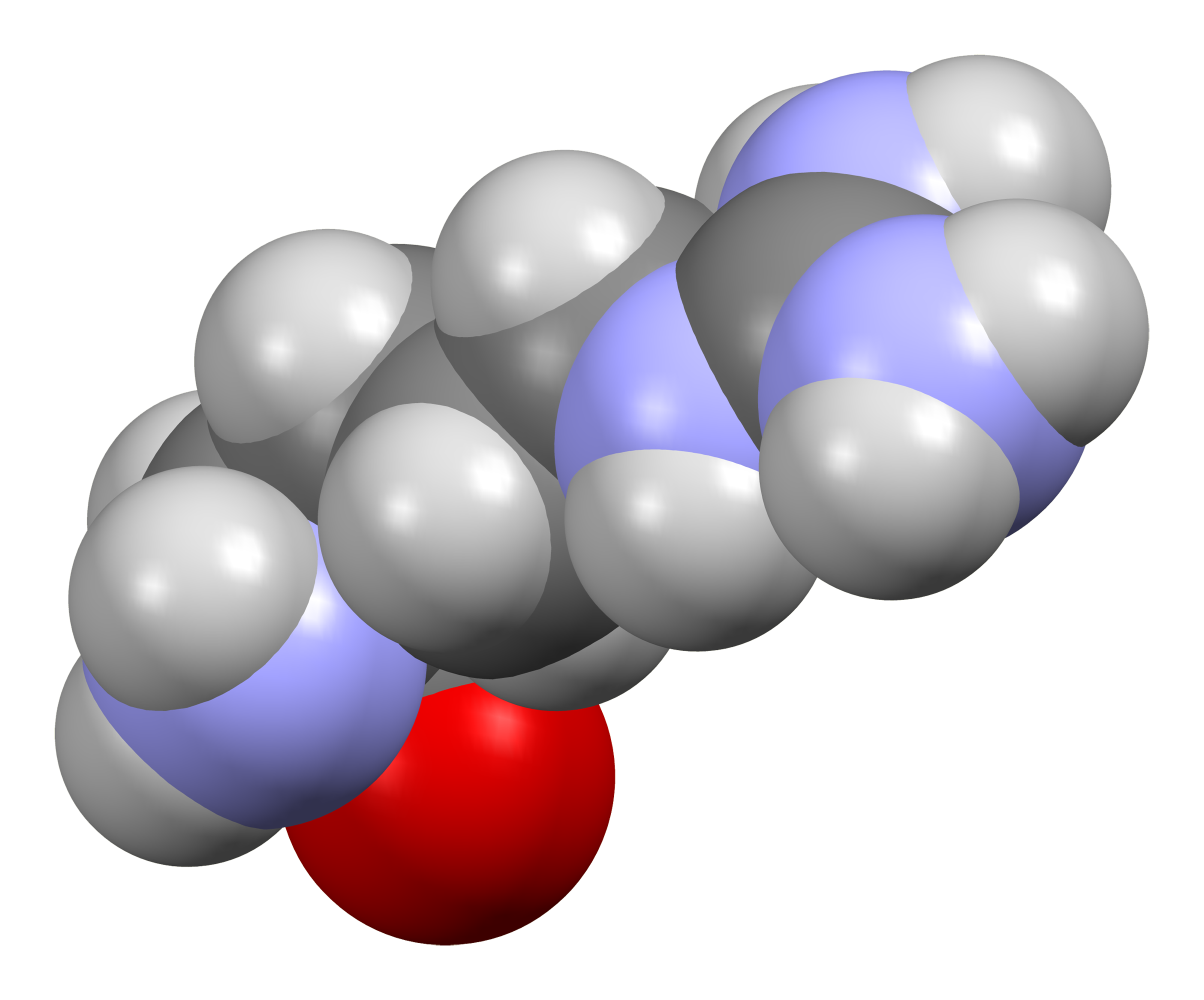
L-arginine is the naturally occurring L-isomer of arginine and is one of the standard proteinogenic amino acids. PubChem identifies L-arginine with the molecular formula C₆H₁₄N₄O₂ and molecular weight 174.20 g/mol.
Its distinctive guanidino group contributes to its basic character and enables L-arginine to participate in several important biochemical pathways.
L-arginine is particularly important in nitric oxide biology because nitric oxide synthase enzymes use L-arginine as a substrate for nitric oxide production.
L-arginine serves as a substrate for nitric oxide synthase. The resulting nitric oxide participates in vascular signaling and vasodilation.
L-arginine participates in the urea cycle, a metabolic pathway involved in nitrogen disposal and ammonia handling.
As a proteinogenic amino acid, L-arginine can be incorporated into proteins during normal cellular protein synthesis.
Arginine availability can influence several metabolic and signaling pathways, making it relevant to nutritional, vascular and translational research.
L-arginine has been investigated across cardiovascular, vascular, metabolic, exercise, endothelial and nutritional research.
Research has investigated L-arginine as a nitric-oxide precursor and its effects on vascular tone and blood flow.
Studies have examined whether increased L-arginine availability can alter nitric-oxide production and endothelial responses.
Clinical trials have evaluated L-arginine in peripheral arterial disease and critical limb ischemia, with mixed findings.
L-arginine supplementation has been studied for nitric oxide, blood-flow and exercise-performance outcomes, but findings are not uniformly positive.
Arginine has also been investigated in nutrition, wound healing, immune and metabolic research contexts.
Arginine salts are also studied as formulation excipients and protein stabilizers, which is a separate application from administering L-arginine as an active nutrient or research compound.
Human research demonstrates that L-arginine can influence nitric oxide biology, but clinical outcomes vary considerably by population, dose, route and indication.
| Research Area | Route | Research Finding | Evidence Interpretation |
|---|---|---|---|
| Nitric oxide physiology | Oral | Human research demonstrated increased exhaled nitric oxide after L-arginine administration. | Supports biological activity but does not establish therapeutic efficacy for a disease. |
| Critical limb ischemia | IV | An IV L-arginine clinical study reported increased femoral blood flow and NO-related biomarkers. | Demonstrates vascular effects in a specific clinical population. |
| Peripheral arterial disease | Oral | A randomized trial did not demonstrate the anticipated clinical benefit from long-term supplementation. | Illustrates that increased substrate availability does not necessarily produce improved clinical outcomes. |
| Exercise performance | Oral | Controlled studies have reported mixed findings regarding performance and nitric oxide responses. | Evidence remains inconsistent and population-dependent. |
Published research has used substantially different L-arginine quantities depending on the research question and route. These examples describe clinical research protocols and should not be interpreted as dosing recommendations.
| Study Context | Route | Research Exposure | Interpretation |
|---|---|---|---|
| Healthy human nitric-oxide study | Oral | 0.05–0.20 g/kg in the published experimental protocol | Used to examine nitric oxide physiology rather than establish a general treatment dose. |
| Critical limb ischemia study | IV | 30 g infused over 60 minutes | Specific research protocol in a defined vascular disease population. |
| Peripheral arterial disease trial | Oral | 3 g/day for 6 months | Long-term clinical trial with no demonstrated improvement in the primary functional outcome. |
| Exercise study | Oral | 6 g before exercise | Controlled study in trained participants; no assumption of universal performance benefit. |
Clinical-study quantities are included to document the scientific literature. They are not recommendations for self-administration, injectable preparation or treatment.
Oral L-arginine has been widely investigated in nutritional, cardiovascular, endothelial and exercise research.
Oral evidence should not automatically be transferred to injectable formulations.
IV L-arginine has been investigated in controlled clinical research, including vascular studies.
Injectable formulations require route-specific pharmaceutical quality, sterile manufacturing and appropriate administration controls.
This distinction is important because L-arginine exists in multiple forms and formulations.
A current L-arginine hydrochloride injectable product is already formulated as a sterile, nonpyrogenic solution at 100 mg/mL. Its label identifies sterile water for injection as the vehicle and specifies formulation-specific storage requirements.
Therefore, it would be scientifically incorrect to take a generic L-arginine powder and automatically apply a peptide-style instruction such as "add X mL of BAC water."
The most important distinction is between a validated pharmaceutical formulation and an unspecified research powder.
| Question | BacScience Position |
|---|---|
| Is BAC water universally established for L-arginine? | No |
| Is sterile water used in an existing L-arginine injectable formulation? | Yes — formulation-specific |
| Does a compatible diluent automatically establish stability? | No |
| Does a mathematical concentration calculation establish pharmaceutical suitability? | No |
| Should the exact formulation documentation control? | Yes |
The existence of sterile water in one approved or commercially formulated L-arginine product does not establish that sterile water, bacteriostatic water, saline or another diluent is suitable for every L-arginine powder. Formulation-specific evidence is required.
For mathematical concentration calculations, the fundamental relationship is:
For example, if a hypothetical research solution contains 1,000 mg of L-arginine in a final volume of 10 mL, its mathematical concentration is 100 mg/mL.
This example is mathematical only. It does not establish that a 100 mg/mL solution is suitable for injection, that a particular diluent is compatible, or that the resulting preparation is sterile or stable.
Open Universal BAC Water CalculatorThe Universal BAC Water Calculator performs mathematical volume and concentration conversions. It does not determine chemical compatibility, formulation stability, sterility, endotoxin safety, pharmaceutical quality or a medically appropriate route of administration.
Vial quantity and final concentration are related but should not be treated as the same variable.
| Variable | Meaning |
|---|---|
| Total compound quantity | The total mass of L-arginine or L-arginine salt in the container. |
| Final volume | The total volume of the finished solution. |
| Concentration | Mass divided by final volume. |
| Salt form | The molecular identity can affect how the labeled quantity should be interpreted. |
| Formulation | Excipients, pH, vehicle and container can materially affect suitability and stability. |
Stability is formulation-specific rather than a single property of "arginine in water."
A current L-arginine HCl injection label specifies storage at controlled room temperature, with excursions permitted between 15°C and 30°C, and instructs users to protect the product from light and deep freezing.
The label also instructs visual inspection for particulate matter and discoloration.
Storage conditions for an unspecified research powder should come from the supplier's validated specifications.
Stability data for one L-arginine formulation should not automatically be transferred to another salt, concentration, pH or container.
Research involving arginine-containing pharmaceutical formulations demonstrates that pH, counter-ion, concentration and formulation composition can influence stability. Arginine salts are also used as pharmaceutical excipients, meaning formulation behavior can differ significantly depending on the application.
Sterility, endotoxin control and chemical purity are separate quality attributes.
A sterile injectable requires appropriate sterile manufacturing or validated sterile-compounding controls.
Low chemical impurity levels do not by themselves prove acceptable bacterial endotoxin levels.
Injectable formulations should be assessed for visible and applicable subvisible particulate requirements.
Dietary, food, research and pharmaceutical material grades should not automatically be treated as interchangeable.
The vial, stopper, seal and storage environment form part of the pharmaceutical formulation system.
Lot number, manufacturer, certificate of analysis and manufacturing documentation should remain traceable.
Researchers evaluating L-arginine material should distinguish chemical identity and assay from the additional quality attributes needed for sterile administration.
L-arginine has an additional role that is important to distinguish from its use as an active amino-acid ingredient.
Arginine and arginine salts are used in pharmaceutical formulation research as protein stabilizers, viscosity modifiers and solubilization aids. Research has demonstrated that arginine's effects can vary with counter-ion, pH and formulation composition.
Therefore, "arginine is compatible with a formulation" is not enough information to establish that a particular arginine powder should be reconstituted with a particular diluent.
L-arginine exists across several regulatory categories, including nutritional products and pharmaceutical formulations. The regulatory classification depends on the specific product, formulation, route, intended use and jurisdiction.
A commercially labeled sterile L-arginine injectable should be distinguished from an unapproved research powder or compounded preparation.
Researchers should therefore avoid describing all L-arginine products as equivalent merely because they contain the same chemical compound.
L-arginine's biological relationship with nitric oxide is well established, but this does not mean that supplementation produces a consistent therapeutic benefit across all diseases.
In a clinical study of patients with critical limb ischemia, intravenous L-arginine increased femoral artery blood flow and increased urinary nitrate and cGMP measures, consistent with increased nitric oxide production. :contentReference[oaicite:2]{index=2}
However, a randomized trial in peripheral arterial disease found that six months of oral L-arginine did not improve the primary functional outcome and produced less improvement in walking distance than placebo. :contentReference[oaicite:3]{index=3}
These contrasting findings demonstrate why mechanistic evidence should not be presented as proof of clinical efficacy.
L-arginine is the biologically active L-isomer of arginine, a proteinogenic amino acid involved in nitric oxide synthesis, protein metabolism and the urea cycle.
PubChem lists L-arginine with a molecular formula of C₆H₁₄N₄O₂ and a molecular weight of approximately 174.20 g/mol.
Not universally. Some L-arginine injectable products are supplied as ready-to-use sterile solutions. An unspecified research powder may require formulation-specific preparation, but no universal reconstitution procedure should be assumed.
BAC water should not be treated as a universally established L-arginine diluent. Compatibility depends on the exact formulation, chemical form, route and supporting documentation.
A current L-arginine HCl injectable product is supplied as a pre-formulated sterile solution using sterile water for injection. This is a formulation-specific fact and does not establish a universal diluent for every L-arginine powder.
Mathematical concentration in mg/mL equals the total amount of L-arginine in milligrams divided by the final solution volume in milliliters.
No. The calculator performs mathematical concentration and volume conversions. It does not determine chemical compatibility, stability, sterility, endotoxin safety or clinical suitability.
No. Human research has demonstrated biological and vascular effects, but clinical outcomes vary substantially by disease and study design.
No. Route-specific pharmacokinetics, exposure, formulation and safety considerations prevent automatic transfer of evidence between routes.
Salt form, concentration, pH, excipients, vehicle, container closure, sterility and storage conditions can all affect the behavior and quality of an L-arginine preparation.
No. L-arginine hydrochloride is a salt formulation containing L-arginine and hydrochloride. The molecular mass, formulation composition and labeling can therefore differ from L-arginine base.
Researchers should review identity, assay, impurities, lot traceability and, where relevant to the intended use, sterility, endotoxin and other pharmaceutical-quality attributes.
Use the BacScience Universal BAC Water Calculator for mathematical concentration and volume conversions. Always verify formulation-specific diluent, stability and quality requirements separately.
Open BAC Water CalculatorSeptember 11, 2026
This page should be periodically reviewed as product labeling, formulation information, clinical research and regulatory guidance change.